Fri, Apr 17, 2026
The Timeless Sparkle of Women's Lives
We're part of a long story of women
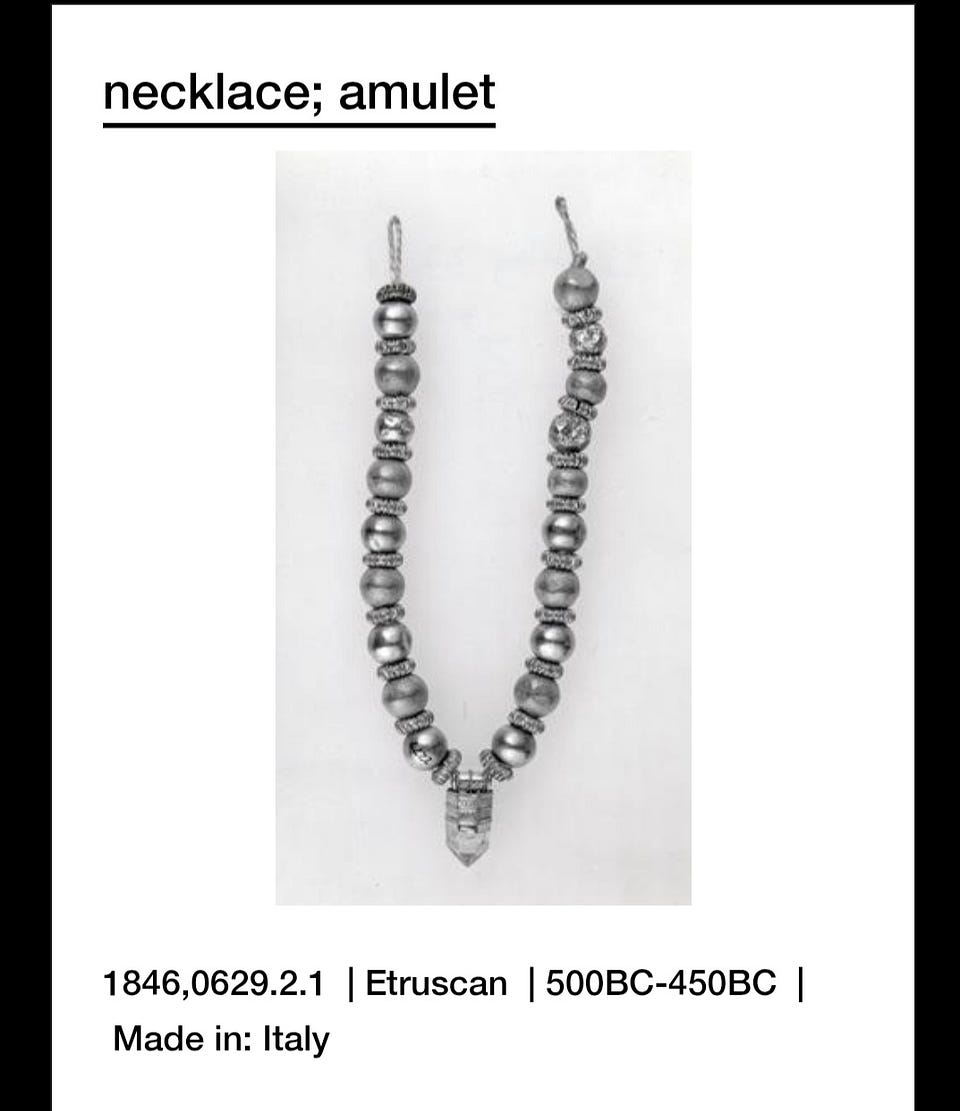
On a recent visit to the British Museum, I found myself lingering in front of the jewelry cases.
Gold necklaces, earrings, and rings—2500 to 3000 years old—sat quietly under glass. And yet, many of them looked surprisingly familiar.
So familiar, in fact, that you could take them out of the case, put them on a woman today, and no one would question it. They would simply look… beautiful.
As I stood there, something shifted. Time folded in on itself.
I could suddenly imagine the women who wore these pieces—not as distant, unknowable figures, but as people I could relate to.
When Power Changes, Style Changes
As I moved through the exhibit, I read a placard describing jewelry trends in the ancient world.
After Alexander the Great conquered vast territories, styles began to shift. Designs took on a distinctly Greek influence—even in places far from Greece.
History usually tells this story through battles and borders.
But here, it was told through earrings and pendants. Through the objects that ordinary women wore in their daily lives.
I found myself wondering:
How would this change have been communicated? (They certainly didn’t have Instagram.)
How long did it take for new styles to appear in the marketplace?
Did women notice it as a shift in power—or just as something new and desirable?
My guess is that it unfolded slowly. Not as a sudden change, but as a gradual evolution. And yet, the pattern is clear enough for historians to trace.
Jewelry became a quiet record of:
Where power had moved
Which styles became fashionable
How political shifts reached right into someone’s jewelry box
Beneath all of that change, something remained:
A woman’s desire to adorn herself with something beautiful.
Women Then and Now
We don’t hear very much about everyday women in history.
When women do appear, it’s often in extremes—villains, scandals, or tragic figures. But the women who wore these necklaces were almost certainly much more like us.
They appreciated beauty.
They paid attention to how they looked and felt.
They worried about their families.
They tried to use their time in meaningful ways.
Their lives were shaped by war, culture, and shifting power—but they still had ordinary days. Private worries. Small moments of joy.
The jewelry is evidence not just of craftsmanship, but of continuity.
They were not so different from us.
Women’s Wisdom, Then and Now
That thought led me somewhere else.
If our desires and worries are so similar… what about our wisdom?
Today, we’re surrounded by advice—books, podcasts, posts, courses. There’s more access to “wisdom” than ever before.
And yet, it doesn’t always make things easier.
Which ideas are actually right for us, right now?
How do we move from “That resonates” to real change?
How do we keep adapting when we’re already tired from constant adaptation?
Women in the past didn’t have self-help sections.
But they had stories. Elders. Community.
They were also trying to figure out how to live well in the middle of change.
In that way, the question hasn’t really changed.
How do I live well, in this body, in this time, with what I know?
The Quiet Work of Being a Woman
When I think about those ancient pieces of gold, two things stand out.
First, a shared desire:
To feel beautiful. To express ourselves. To hold onto something that feels precious.
And second, a shared kind of labour:
The ongoing, often invisible work of adjusting to new realities, caring for others, and still trying to care for ourselves.
The gold survives in museum cases. Their daily worries don’t.
But it’s not hard to imagine them—because in many ways, we’re still living them.
We are not the first women to feel tired.
To crave beauty in the middle of chaos.
To search for wisdom and struggle to apply it.
We stand in a long line of women who have faced change, reached for beauty, and tried—again and again—to make a life.
And that, to me, is the quiet message behind all that glittering glass:
We are part of something larger.
And we are not alone.